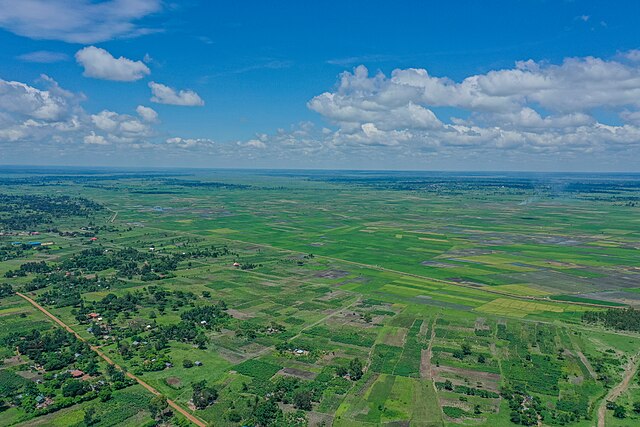
The National Agricultural Research Organisation (NARO) of Uganda and the Japan International Cooperation Agency (JICA) are developing homegrown aromatic rice (oryza sativa) varieties to boost production.
According to the NARO’s cereals program leader Dr. Jimmy Lamo on December 11, 2025, the new varieties currently await governmental approval.
The initiative partly seeks to benefit farmers by reducing costly basmati imports under the Promotion of Sustainable Rice Development (ECO-PRiDe Project).
Dr. Lamo echoes this vision by saying that aromatic rice monopolizes local markets yet home cultivars are low-yielding.
This is why the new varieties have keyed in not only aroma but quality seeds that will enhance yields and withstand pests.
The ECO-PRiDE Project’s chief advisor Dr. Kisho Miyamoto echoed this view by championing Japan’s rice expertise in Uganda through quality seed deliveries.
Real-time tests to evaluate varietal feasibility of the new rice seeds are happening across the industry – from farmers to millers.
The NARO is clearing final huddles, including submitting the novel cultivars to the National Variety Release Committee for approval.
Aromatic Rice Demand: Imports Equal Production
Upon approval, the aromatic varieties could altogether replace basmati imports from foreign sources, according to the research team.
In 2023, for example, production tailed off at 260,000 tonnes while imports equaled them at 241,962 tonnes, per the World Bank.
Tanzania supplied the lion’s share at 231,150 tonnes, with Pakistan and India following with 8,337 and 1,350 tonnes, respectively.
The two south Asian countries in particular raise the import bill for they supply Uganda with expensive aromatic basmati and supa rice.
Most of the suppliers of local rice are smallholder farmers who make up 80% of all growers nationwide.
These growers often cope with occasional governmental bans on farming in the wetlands, particularly in 2021. For this reason, rice self-sufficiency in Uganda was at 67% in 2023, according to the CGIAR. And rice consumption in Uganda is rising faster than production, per the following industry data on all varieties, including aromatic.
Uganda Rice Statistics
Rice is one of the staple foods of Uganda. The grain represents 15% of the annual cereal harvest, as of 2021. This makes Uganda one of the top 5 rice-producing nations in East and Southern Africa. But the country imports as much as it produces. This is because consumption has been growing by 4% a year in the early 2020s, against sharply fluctuating production. While 2022’s output hit 347,000 tonnes, 2023’s slumped to 260,000 tonnes, according to the Food and Agriculture Organization (FAO).
Low yield rates in rain-fed areas are the primary causes of production stagnation as they average 1.3 tonnes a hectare (2023). These rain-dependant areas in eastern and northern Uganda however have a productivity capacity of 5.5 tonnes a hectare. They supply 90% of the national rice harvest while the highly productive irrigated areas manage a 10% share.
As a result, imports continue to saturate local markets, averaging 241,962 tonnes (2023), according to the World Bank. This means budgeting each year for over $23.2 million in import bills. As mitigation, the government considers investing $95 million in seed, fertilizer, irrigation and new cultivar research, to attain self-sufficiency.
How much rice do people in Uganda eat per year?
The rice per capita in Uganda is the lowest in East Africa at 14.2 kg per person per year, as of 2022. Conversely, neighbors Kenya (21.5 kg/per capita, 2022) and Tanzania (38.5 kg/per capita, 2022) have bigger appetites. In rice consumption volume terms, Uganda ranks 53rd highest in the world.
Does rice production fluctuate much in Uganda?
Uganda records sharp historical fluctuations in annual rice output due to poor yield rates and pests. For example, production changed by as much as 107.8% between 2019 and 2022, per the FAOSTAT table below:
| Year | Production [tonnes] | Acreage [Ha] |
| 2023 | 260,000 | 200,000 |
| 2022 | 347,000 | 231,000 |
| 2021 | 327,900 | 219,000 |
| 2020 | 275,000 | 221,000 |
| 2019 | 167,000 | 177,000 |