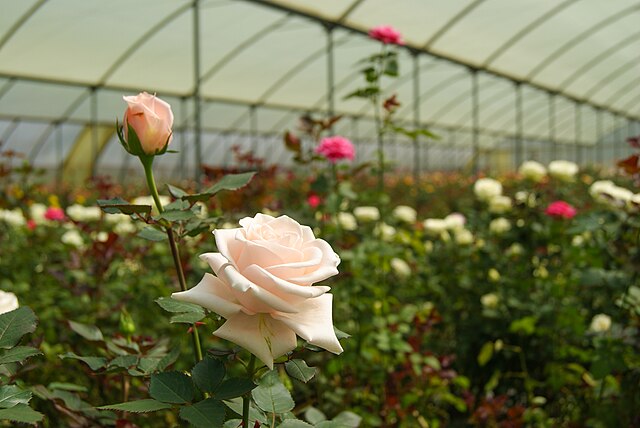
Kenya has hailed rapid progress in exporting flowers to Georgia during a bilateral meeting in Tbilisi on December 11, 2025.
Agriculture Cabinet Secretary Mutahi Kagwe told Georgia’s Environmental Protection & Agriculture Minister David Songulashvili of an aim to “expand top exports.”
He cited flowers as Kenya’s leading export to Georgia in 2024 at 777.8 million shillings ($6.033 million), ahead of tea.
The East African country already enjoys favorable trade surplus over its European trade ally. Total outbound bilateral exports in 2024 clocked 821 million shillings ($6.36 million) versus inbound shipments worth 58 million shillings ($449,268).
Georgia does not seem to rue the imbalance for Minister Songulashvili instead used the meeting to explore future partnerships via a new memorandum.
The Kenya-Georgia Agriculture Memorandum of Understanding seeks to boost private sector and bilateral partnerships in agro-processing, storage and logistics.
Georgia’s import companies particularly dedicate themselves to quality cut flower arrivals from East Africa by anticipating shipments with cold chain facilities.
Most dispatches time Valentine’s Day (February), Women’s Day (March) and Mothers’ Day (May) when it is relatively cold, thus reducing cold chain expenses.
Flowering Europe
In trade terms, Georgia exemplifies the high demand for Kenya’s quality roses, mums, and tulips in Europe.
Floral imports by Tbilisi have been growing steadily in the half decade ending 2024, in tandem with similar global import growth projections.
The country’s imports of cut flowers and buds from Kenya rose sharply from $408 million in 2020 to $5.8 million in 2024.
While some of these flowers reach Georgia directly by air, most are re-exports from auctions in the Netherlands. Dutch auctions account for 50% of Kenya’s sales, leaving 25% as direct exports to floral shops and supermarkets in the UK.
Nairobi dispatches 70% of its global flower trade to continental Europe which in turn represent 40% of worldwide flower imports by Europe. This lion’s share gets further spotlight in the below data section that prioritizes economic benefits and Georgia’s import role.
Kenya to Georgia Flowers Statistics
Floriculture is the most lucrative horticultural activity in Kenya economically, for it represents 70% of the national horticulture export value. It directly employs around 150,000 workers and injects $1 billion to the GDP yearly, according to the BBC. Some $884 million from the sector comes through the taxation of farm activity and exports. The Kenya Flower Council cites that the flower industry indirectly benefits 500,000 people while other sources cite 2 million people. Most of the success of the sector emanates from exports worth $809 million annually, equal to almost 1% of GDP (2021). While there are over 60 export destinations worldwide, Europe is the recipient of 70% of the dispatches. A growing destination within Europe is Georgia, which in 2024 purchased 777.8 million shillings ($6.033 million) in cut blooms and buds from Kenya.
The below data snippet from Trading Economics shows Georgia’s exponential import trends for cut flowers from Kenya:
| Year | Import Value |
| 2024 | $5.8 million |
| 2023 | $4.42 million |
| 2022 | $2.68 million |
| 2021 | $1.31 million |
| 2020 | $478,000 |
Despite the above rapid growth, Georgia trails Europe’s big four importers that control almost 70% of Kenya’s global floral exports. These include the Netherlands (43.3% share), the UK (17.1%), Germany (5.8%) and Norway (5.6%), per the International Institute for Sustainable Development (IISD).
How many flower farms are there in Kenya?
Kenya is home to around 220 flower orchards in its highlands, Lake Naivasha basin and the Rift Valley. Some of these farms care for the environment by targeting to reach zero emissions and sell non-emitted gases as carbon credits.