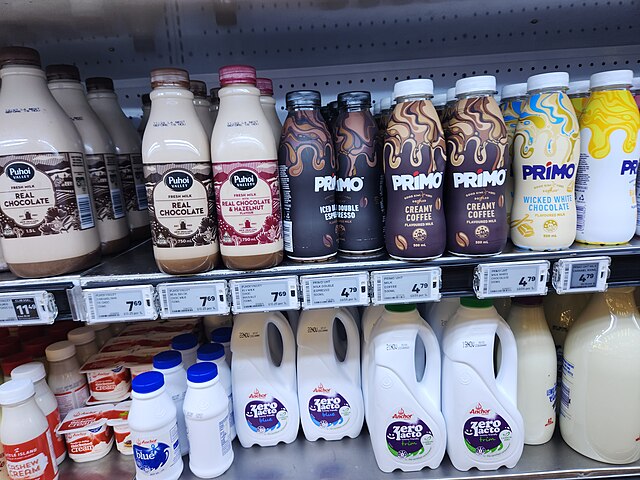
Industry stakeholders from over 60 nations including keynote New Zealand are observing the World Dairy Summit in Santiago, Chile, on October 20-23, 2025.
This year’s theme is “nourishing a sustainable world” with particular emphasis on facilitating technology.
The International Dairy Federation (IDF) via its president Gilles Froment says the 2025 schedule incorporates a program showcasing innovations.
Innovation highlights include artificial intelligence in dairy, nutritional science and tech that promotes sustainability.
While various governments are making sustainability progress, only a few have emission plans for their dairy sectors. Among these is Denmark with its 120-Krone ($17.38)-per-tonne climate tax on livestock emissions in a 2030-35 transition.
Another is New Zealand, whose main ideal is improving the efficiency of its 4 million tonnes of annual dairy shipments.
Notably, the country’s Minister of Biosecurity, Food Safety & Associate Agriculture Andrew Hoggard jetted to Santiago on October 19 with trade ambitions.
Foremost is doubling national dairy exports and expanding their net value to above the reigning NZ$27 billion ($15.5 billion).
Hoggard is also championing local dairy abroad “to support the success of Kiwi farmers and processors.”
After the summit, the minister will tour Uruguay where his country has set up a bioscience factory.
A leader in butter oil and cheese production, New Zealand is focusing on expanding trade of premium milk products.
GDT
Regarding trade, various market changes have happened since the last World Dairy Summit on October 4, 2024 in Madison, WI, United States.
Keynote is the rise and fall of dairy rates at the Global Dairy Trade (GDT) auction in Auckland through the past year.
The auction’s index dropped early 2025, then rallied on May 7 by 4.6%, only to plunge by 4.1% on July 1.
Most recently, the GDT index lost by a significant 4.3% in the first week of September 2025 versus two weeks earlier. Significance lies in the fact that the index sways international markets and nurtures innovation.
And it is not just NZ that is making such innovation advances. According to the IDF, summit host Chile has 2,300 milk farmers and over 10 major processing brands that foster sector innovation. The below statistics in turn show the countries lionizing the world’s dairy sector, among other facts.
World Dairy Statistics
The global dairy sector provides over 80% of the world with primary nutrition and employs 0.6 billion people. As of 2023, the universal dairy product consumption per capita stood at 119.1 kg per person per year.
In production terms, unprocessed whole milk reached 964 million milk solid tonnes in 2023, per a 2024 International Dairy Federation (IDF)’s report. Cheese output in its part hit 23.8 million tonnes while buttermilk 13.2 million tonnes. This is even as whole milk powder production realised 4.7 million tonnes (all 2023 values).
Which countries produce the most milk worldwide?
India leads milk production at 239.31 million milk solid tonnes, ahead of the United States at 102.7 million tonnes (2023). Pakistan, China and Russia follow suit with 64.58, 46.79 and 33.8 million tonnes, respectively, as of 2023. Brazil comes sixth with 36.74 million tonnes while New Zealand caps the top seven with 21.25 million tonnes (2023).
Will the global dairy production grow in value?
An Organisation for Economic Co-operation and Development (OECD)-FAO forecast puts the world’s dairy production at 1.039 billion tonnes by 2032. Overall industry output growth will remain sustained at 1.5% per annum between 2025 and 2032. Cow milk will have a category production share of 81% while buffalo milk 15% and goat milk 4%.
Which is the top dairy product from New Zealand?
With its high livestock density, New Zealand is the world’s top provider of such dairy products as butter/butter oil. It is also a top 3 world leader in cheese supply at 374,000 tonnes (2023). NZ also comes 2nd and 3rd respectively in skim milk powder at 451,000 tonnes and milk/cream at 406,000 tonnes.