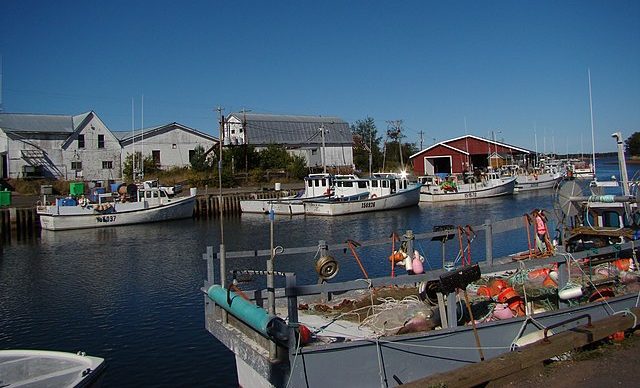
Eastern Cape Breton in northern Nova Scotia in Canada has made a leap by electrifying an indigenous lobster fleet towards zero carbon emissions.
The Membertou Electric Lobster Commercial Demonstration Project thereby launches the Membertou First Nation fishery into zero emission status.
Cape Breton island, home to the indigenous Membertou community, lands from 25% to 40% of Nova Scotia’s annual lobster value.
With beginnings in December 2023, the community project made headway in January 2025 by launching a blueprint of the Letrike’l Walipotl electric boat.
The lobstering boat has bi-directional powering capabilities, which means idle batteries can sometimes supply power to the provincial grid.
Letrike’l Walipotl boasts a streamlined featherweight body with a battery holding up to 500 kilowatts of power for full day fishing.
By using a motor instead of fuel-guzzling diesel engine, the vessel promises to recoup investment costs in the long haul.
Many such boats could cut provincial lobstering emissions to the equivalent of eliminating 35,000 vehicles off-road for a year.
This would however need to incorporate other fisheries like southwest Nova Scotia‘s, which recently began the 2025-26 winter harvest.
A project of the Membertou community and three separate entities from Canada, it has cost C$4.4-million ($3.183 million).
The national Ocean Supercluster (OSC) provided C$1.5 million ($1.085 million) while Halifax’s Allswater Marine, BlueGrid and Oceans North offered technical help.
Allswater Marine assessed in February 2025 that fishing inside 20 km2 off Cape Breton would require 2,300 electric lobster vessels.
Some 60% of these would each consume below 400 kilowatts per 12-hour fishing session, optimizing battery power.
The project is among the OSC’s five projects in Canada worth C$34.5 million ($24.96 million). This quintet targets to extend clean energy solutions to indigenous fisheries.
By March 2025, the organization had generated 10,000 jobs and at the same time channeled C$1 billion ($723.7 million) into the national GDP.
Counting in its electric lobstering project, the entity wants to grow the national blue economy fivefold by 2035.
The Nova Scotia clean energy project is important for its vision promises electrifying the entire provincial lobster fleet. For a review of the current electrification status, see the below statistics.
Nova Scotia Lobster Fleet Electrification Statistics
Nova Scotia is a fabled source of Atlantic lobster, with landings totaling 51,000 tonnes annually (2014). The lobster industry represents 80% of the provincial seafood value while the rest comes from scallop and other ocean life. According to the government of Canada, the province lands around C$570 million ($412.5 million) in lobster annually. Emission from diesel-propelled boats is a key challenge that the provincial and national governments want to eradicate by 2050. Towards this goal are electric boats, the first of which being northern Nova Scotia’s Letrike’l Walipotl, operational late 2025.
Oceans North argues that electrification could raise economic activity in the province to a worth of C$10 billion ($7.23 billion) annually. The action would eliminate the 82 million kg of CO2, equivalent to driving 35,000 vehicles a year. Oceans North therefore considers the net zero ambitions achievable by 2050. This is if the province electrifies 15% of its boats before 2030 as well.
Attention is also turning to hybrid engine with diesel and motor capabilities. This is a cheaper option that could thus cut total emissions considerably. It could also bring fuel savings of around 30 to 40% per year.