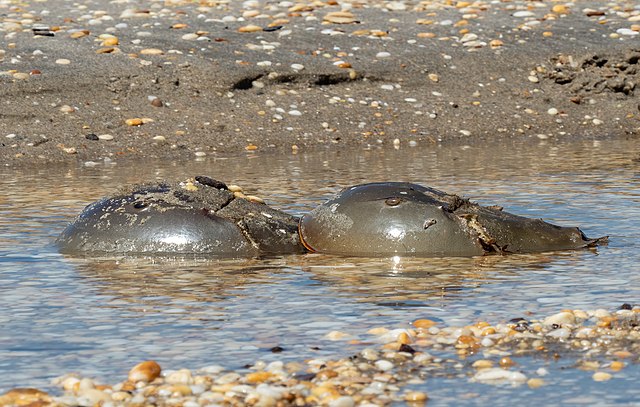
The Center for Biological Diversity on January 5, 2026 litigated against the National Marine Fisheries Service for falling behind giving horseshoe crab protection.
According to the South Carolina agency, the administration is yet to signal whether to draft the prehistoric critters into the Endangered Species Act.
It all started on February 12, 2024 when the center petitioned the National Oceanic and Atmospheric Administration (NOAA) to list the species as “living fossils.”
The agency’s southeast director Will Harlan says that a response that ought to have come in 3 months was still wanting 19 months later.
According to the litigants, the 445-million year crab species are important for biodiversity since their eggs feed several migratory shorebirds.
One of these is the tufa red knot, which eats crab eggs in its 28,800-km flight from Argentina to Canada.
Although already in the Endangered Species Act since 2014, red knots are finding lesser and lesser eggs each year.
According to the Earth Island Institute, the red knot count is down 75% since the 1980s. The decline is at par with the horseshoe crab population that has historically slumped by 70%.
This is despite a female being capable of laying 100,000 eggs annually, mainly in the shores of South Carolina.
Biomedicine
The same year red knots won their endangered listing, the center for Biological Diversity forecast future biomedical harvest bans.
Biomedical researchers bleed the live crab for its blue blood to test vaccine purity before putting it back into the ocean.
On June 7, 2024, New York passed an initial Horseshoe Crab Protection Bill that banned biomedical harvests on the Long Island Sound.
New York governor Kathy Hochul would later veto the bill until the senate re-passed it a year later in June 2025. This time round, Hochul signed the bill in December 2025 and set a full ban date for 2029.
Even though the main habitat of the crab is the Delaware Estuary, egg-laying grounds like South Carolina draw environmentalists to protect biodiversity. Current horseshoe crab protection status forms the topic of the statistics below.
Horseshoe Crab Protection Statistics
For over 400 million years, the horseshoe crab have reigned supreme in the southeast United States’ waters. Until the 1980s, they fared fairly well but since then their population has declined by around 70% from over-harvesting and biomedical use. According to the Defenders of Wildlife, about 700,000 horseshoe crab disappear off beaches annually during spawning while 30% die upon return to sea following biomedical bleeding. For this reason, environmentalists have been agitating protection through harvest bans and other official protection.
In February 2024, the Center for Biological Diversity petitioned the National Marine Protection Service to enlist the critters into the Endangered Species Act. Nearly two years later in January 2026, they launched a lawsuit against the federal agency for non-action.
Which habitats need protection?
Horseshoe crab habitats curve northeastward from Florida through Maine, spanning 15 east and southeast states. Delaware has possibly the highest population globally, which it protects with a 1,500–mile. horseshoe crab sanctuary. Nearby states enforce a yearly harvest quota of 150,000 crab, but even this is increasingly reducing.
Are there states that have banned horseshoe crab fishing?
Some of the habitats that have officially offered protection include Long Island Sound, off New York. In June 2025, governor Kathy Hochul finally agreed to enforce a full harvest ban in 2029. Beforehand, the governor had vetoed a similar ban at a time when NY offered an annual horseshoe crab fishing quota of 150,000 units.