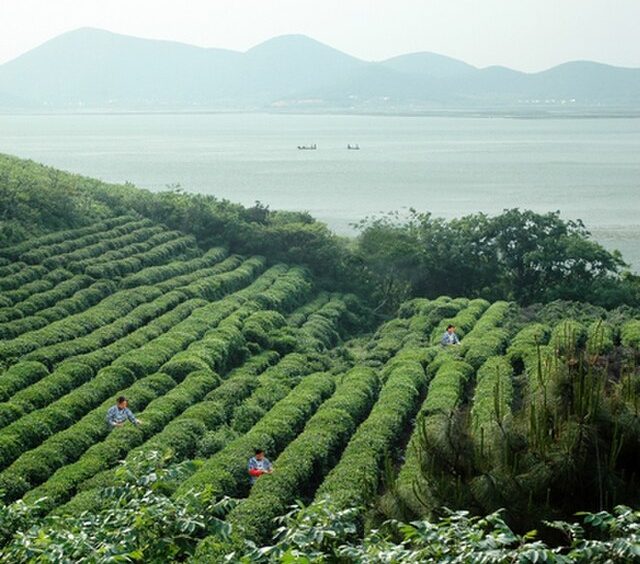
East China’s Zhejiang tea harvest is back March 2025 as farmers around Qiandao Lake in Chun’an county pick their first buds.
The lake side area is a conducive plantation crop haven for it enjoys a lush forestry belt, reports CGTN. Here, smallholder tea estates thrive undisturbed by other crops except vegetables, making its tea uniquely flavored.
Zhejiang’s undulating landscapes produce China’s unique “West Longjing tea” that echoes the rival Sichuan’s pan-fried tea.
Multiple varieties abound, with green tea dominating the unique dark- and bright-tinted teas of the region.
Area specialties include the conventional black, white and yellow teas, alongside hei (dark tea) and wulong. The last two cultural types command 13.7 and 10% of the harvest, respectively, with dark tea the cheapest.
90% is Hand-picked
The start of the current harvest marks a lengthy Zhejiang season that will last till mid-October, with most picking meticulously manual.
To fulfil this demanding manual task, small-scale farmers start the work before dawn every 2 to 3 days a week.
Although machines contribute 10% of the labor input, almost all the harvest is by hand, which ensures sustainability.
Zhejiang’s Tea Museums/Institutions
With such a well-heeled tea culture, it is inevitable that the region should boast tea museums and institutions.
One of the latest museum showcases took place in January 2014 at the Zhejiang Provincial Museum in Hangzhou.
The exhibition, entitled “The Spectacle of tea,” showed visitors cultural relics that characterize the regional product.
Teaching institutions include the Zhejiang University Tea Research Institute in Shaoxing and the Jinhua Mingye Tea Zixonghe Utilization Institute.
Both educational centers carry out scientific studies on varieties and also train on the local tea culture and etiquette.
So, as an eastern province begins its 5-month tea harvest, will it help keep China top producer of tea worldwide? Time will tell, but as the statistics below show, it is almost a certainty that it just might!
China Tea Statistics
China is not only one of the oldest tea civilizations but the producer of about half of the world’s tea. In 2023, China’s total share in global production was 50.6%, equal to 3.3 million tonnes of processed tea. Fresh tea leaves meanwhile hit 16.013 million tonnes in 2023, from the 15.01 million tonnes of 2022, per FAOSTAT.
The country commanded 2,856,447 hectares (ha) of tea in 2023 while in 2022 the acreage had reached 2,819,011 ha. Most of this plantation area lies in the southwest, central, eastern and Yangtze River’s banks.
Which are the tea provinces of China?
Southwest China leads national tea production, with Yunnan, Guizhou and Sichuan the leading provinces here. The central China region boasts another top 5 tea producer by cultivated area, namely Hubei province. Other major provinces are in the south of the Yangtze, namely Hunan and Zhejiang.
Which is the most valuable tea brand of Zhejiang?
“West Longjing tea,” a brand name for a regional tea from near the provincial capital, Hangzhou, is quite valuable. In 2023, the province produced 490 tonnes worth 600 million yuan ($84.6 million) of this specialty type.
Which main tea varieties are there in China?
Although there are hundreds of types by locale, there are six major varieties, namely green, oolong (wulong), black, yellow, and puerh (dark). In most regions, green tea accounts for 85% of varietal production, which is true of Zhejiang.