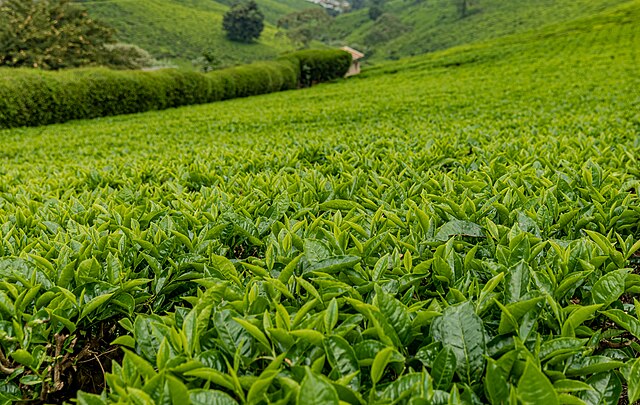
Targeting to unyoke smallholder farmers from perennial unfair bonuses, Kenya might double farm-level green tea prices to 100 shillings ($0.77) a kg in 2027.
Unveiling a seven-pillar strategy to improve the producer price, Agriculture Cabinet Secretary Mutahi Kagwe promised to equate producer prices irrespective of region.
Among the seven pillars is a minimum farm-gate price and the establishment of a quality testing lab in the export gateway of Mombasa.
According to Kagwe, the laboratory is currently undergoing equipping and will be ready to operate by June 2026.
Quality remains one of the major focus to protect Kenya’s prized tea in markets that also grow their own tea such as India and Pakistan. The two south Asia nations mainly use the Mombasa Auction for their imports.
Hence, Western Kenya tea belt will initiate a 24-month quality improvement program for transiting from medium quality to premium quality tea within half-a-decade.
A governmental board will blind-taste teas from various factories, whereby 15 factories with substandard tea will join the quality enhancement program.
The Tea Board of Kenya (TBK) will hence peg pricing to its sensory analysis on top of scientific lab assessment for pesticide content.
Need for Parity
Price reforms come in the heels of inquiry findings by the National Assembly Agriculture Committee that cartels manipulate rates by region.
Producer associations often clash with brokers who take advantage of ever-changing international prices to exploit farmers.
Indeed, farmers from the southwestern Kenya areas of Kisii, Nyamira and East Rift Valley precipitated the price equalization agenda by protesting unfair tea bonuses.
Growers of the premium traditional tea will access a 3.7-billion shilling ($28.6 million) loan via the Kenya Development Corporation to raise standards.
How well the oncoming reforms elevate the Kenya tea quality parameter depends much on the actualization of the price hike. This is because smallholder farmers grow over 66% of national tea. The stats below follow their plight via a price analysis.
Kenya Tea Export Prices Statistics
Tea is economically important in Kenya for it employs 13% of the population, earns 26% of the foreign exchange and represents 4% of the GDP. At the farmer level, however, reforms are in need to raise income due to long-term price manipulation. The government promised to raise the farm-gate price from 50 shillings ($0.39) a kg to 100 shillings ($0.77)/kg starting 2027.
Kenya’s tea sells at the international level via auctions. The following data interpretation from the Federal Reserve, St. Louis gives a mid-year historical perspective on the global price:
| Year-to-Date | International Price of Kenya Tea [$/kg] |
| June 2025 | 3.06 |
| June 2021 | 2.28 |
| June 2015 | 3.55 |
| June 2007 | 2.02 |
| June 1998 | 2.18 |
| June 1995 | 1.45 |
| June 1990 | 1.81 |
How did Kenya Tea auction prices perform over 2025?
2025 started strongly in pricing before experiencing several rise and fall patterns, per the below YCharts-interpreted data:
| Month [2025] | Auction Price |
| September | $3.24 |
| August | $3.02 |
| July | $3.04 |
| June | $3.06 |
| May | $3.19 |
| April | $3.16 |
| March | $3.21 |
| February | $3.33 |
| January | $3.43 |
How big is tea production in Kenya?
Despite acreage shrinking from 269,400 hectares (ha) in 2020 to 227,800 ha in 2023, production levelled off somewhat in the same period. According to data from the FAOSTAT, Kenya produced 3.05 million tonnes (t) of tea leaves in 2020. This reduced to 2.43 million t in 2021, then to 2.418 million t in 2022, before rising to 2.5778 million t in 2023.