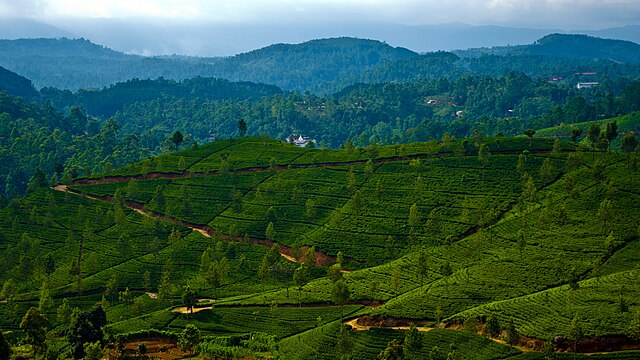
There is only minimal impact of cyclone Ditwah on inundated tea plantations in Sri Lanka that grow various Camellia sinensis varieties, an industry body says.
Analysts labeled the early December 2025 cyclone that impacted over 2 million people, including tea growers, the worst in a century.
It even prompted President Anura Kumara Dissanayake to declare a state of emergency in 22 of the country’s 25 districts.
But according to the Colombo Tea Trader’s Association (CTTA), the tea sector merely incurred transport disruption and machinery damage, for operations are back.
The statement underlines the fact that the cyclone hit in the harvest season when bulk deliveries to mills take place on hilly roads.
Some of the plantations are in low-lying areas at elevations below 600 meters above sea level, hence their vulnerability.
Tea regions such as Uva and Central province suffered direct impact, with roads undergoing temporary closure, according to the CTTA.
The association adds floods from Kelan River limited access to warehouses and damaged bagging machinery but swift repairs are underway.
Regarding production, the CTTA put January-October 2025 output at 220.98 million kg nationally, 3.3 million kg up, year-on-year.
Plantations as “Wasteland”
However, an Al Jazeera report of December 10 reveals that the country’s famous tea sector could see production plummet by 35% this year.
Describing the devastation as a “wasteland,” the news line quotes an analyst saying that Ditwah’s economic impact could equal that of the 2004 tsunami.
Beforehand in October, the Tea Exporters Association of Sri Lanka (TEASL) had targeted to surpass 2024’s export earnings by earning $1.5 billion in 2025.
Whether this is possible after the weather event remains unclear but there are still hopes that 2025 might still post gains.
Illustrating industry resilience, the CTTA has not cancelled harvest-time auctions but has instead pushed them to future dates.
One of these is the early December auction that has moved to end month to ensure smooth financial flow for producers, including small-scale growers. Regional topographical diversity that extends the harvest also helps maintain constant flow in financial and production terms. And as the following data reveals, tea production in Sri Lanka takes place in plantations across different altitudes.
Sri Lanka Tea Statistics
Sri Lanka grows tea in two diverse terrains: highlands (1,800 m) and mainly low-lying seaboard areas at elevations of 0 to 600 m above sea level. This helps create consistent harvests, apart from cyclone times when low-lying regions suffer damage. These regions cultivate either traditional tea (Camellia sinensis var. sinensis), speciality tea (Camellia sinensis var. assamica) or both.
In a good year, Sri Lanka ranks 4th in global tea production, behind Kenya, India and China. In the 2024-25 season, the country produced 1.4 million tonnes, versus Kenya’s 2.326 million tonnes, India’s 5.969 million tonnes and China’s 14.54 million tonnes. Historical production has remained steady, per the following data interpretation from the FAOSTAT:
| Year | Tea Leaves [tonnes] | Green Tea [tonnes] |
| 2023 | 1,433,543 | – |
| 2022 | 1,400,000 | 251,499 |
| 2021 | 1,800,000 | 199,488 |
| 2020 | 1,500,000 | 278,489 |
| 2019 | 1,490,000 | 300,120 |
Is Sri Lanka’s tea productivity excellent?
Sri Lanka is the world’s top producer of tea in per capita terms. Each person produces 65.39 kg of tea per year, as of 2024-25. Only Kenya and Türkiye at 42.03 and 14.9 kg per person per year, respectively, come near.
How does Sri Lanka export its tea?
About 50% of the tea Colombo exports is value added, meaning it is either organic, flavored, green, instant or iced. The tea ships in either bulk bags or tea packets. In 2023, exported tea packets clocked at above 108 million kg, worth almost 180 billion Sri Lankan rupees ($583.38 million).