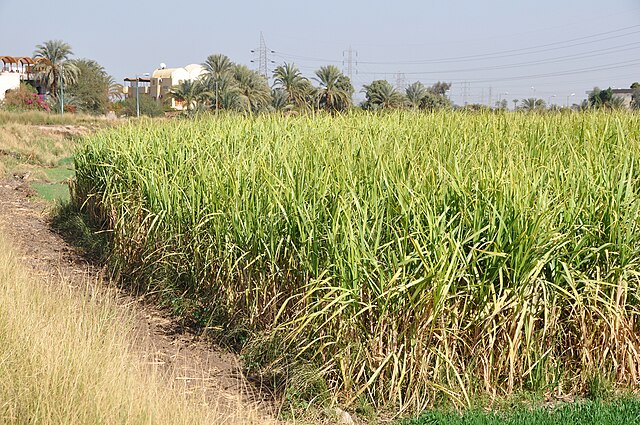
Egypt and Saudi Arabia have entered a new chapter for harvesting sugarcane in the Middle East and Africa (MEA) region.
For Egypt, it is a new double-harvester that will likely bring sugarcane cutting efficiency to 100%.
A research on the journal Scientific Reports introduces the revolutionary machine, via an Agritech Insights story on December 7, 2025.
The Aswan University’s Engineering Department says its semiautomatic whole-stalk sugarcane harvester (SWSH) will be simultaneously cutting double rows spaced at 0.71-0.80 m.
This will accelerate the harvesting rate to 3 to 4.5 km per hour using only two cutters, at a cost of $4.42 a hectare.
Research leader Abdallah E. Elwakeel cited cost efficiency for farmers by recounting how the harvesting equipment will usher profitability and sustainability.
The development seems to clinch the case for the sugar industry of Egypt, which has achieved self-sufficiency this 2025-26 season.
During the current harvest year, farmers attained 2,500 Egyptian pounds ($52.48) a tonne, versus 3,000 pounds ($62.97) a tonne for sugar beets.
Saudi Cultivates the Temperate Southwest Region
In the same week when Egypt was researching its seminal double row harvester, across the Red Sea a sugarcane oasis was bubbling.
This is the temperate Najran area of southwestern Saudi Arabia, where farmers have recently drawn attention due to their production methods.
According to the Saudi Press Agency via Gulf Trick on December 7, 2025, Najran and surrounding areas of Jazan, Baha and Asir are making cultivation waves.
Growers here have learned to patiently wait for eight months before harvesting their crop to raise its sugar yield.
They leave the crop fertilizer-free in the final 90 days and irrigation-free in the last three weeks to boost sweetness levels.
Ibrahim Shakwan, a farmer from Najran told the press that he has seen his crop on 7.3 hectares turn a success.
Shakwan finds productivity here as capable to meet emerging regional interest in cane due to its lucrativeness.
This is true because high appetite for sugar and sweet products drives sales in the Gulf country. Saudi Arabia ranks 60th in global sugar consumption (2021), a relatively high position, according to the Helgi Library.
The kingdom thus looks likely to emulate its regional neighbor Egypt as a production leader in the Middle East. This regional interest forms the topic of the following look at the sugarcane industries of these two nations of the MEA region.
Saudi Arabia’s and Egypt’s MEA Sugarcane Statistics
Sugarcane is a major industry crop in North Africa and Western Asia, particularly Egypt and an emerging Saudi Arabia. Egypt ranks in the top 16 global producers of the crop and 2nd in Africa after South Africa. The North African nation has been producing at least 15 million tonnes of cane annually in the 2019-23 period. This is per the below FAOSTAT’s data interpretation:
| Year | Harvest Total [tonnes] | Harvested Area [Ha] |
| 2023 | 15,269,136 | 139,547 |
| 2022 | 15,564,534 | 140,018 |
| 2021 | 15,959,306 | 143,857 |
| 2020 | 15,860,450 | 217,625 |
Is sugarcane the chief sugar raw material in Egypt?
Despite its prominence, sugarcane is not the chief source of sugar in Egypt. In the 2025-26 season, 2.5 million tonnes of sugar came from beets while 620,000 tonnes from cane.
In terms of sugar processing, Egypt manages 2.6 million tonnes per annum, per a U.S. Department of Agriculture (USDA)’s 2024-25 projection. The processing capacity could be more but for the fact that cane farmers sometimes deliver their raw material to molasses’ plants. According to the Ministry fo Agriculture & Land Reclamation, the country attained self-sufficiency in the 2025-26 season by producing some 3 million tonnes.
How is the sugarcane industry of Saudi Arabia?
Saudi Arabia, on the other hand, might produce 15,200 tonnes of cane in 2026, according to a Report Linker forecast. This renders the country more of a consumer of sugarcane than a net producer, at position 28 among sugarcane-utilizing nations. Much of this utility goes to sugar: according to the Helgi Library, the country consumes up to 28.9 kg per person per year (2021) and as low as 5.97 kg per capita (1962). This effectively renders the KSA the 60th biggest sugar-consuming nation among 165 select nations.