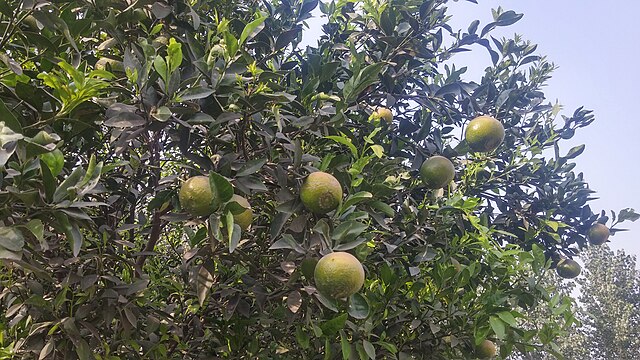
In the just beginning 2025-26 citrus marketing season in Pakistan, trade is finally coming to terms with lowering seasonal exports since 2021.
Marketers predict similar falls for the current marketing year as previously, particularly if the strategic Afghan border remains shut.
According to Dawn on December 8, 2025, Afghanistan absorbs 60% of national citrus exports because of low quarantine regulations there.
With the border closure since October 15, attention is turning to other traditional destinations like Uzbekistan and Kazakhstan.
These two countries however depend on Kabul’s closed transit while the alternative Iran route is impractical due to international trade sanctions.
Down Memory Lane
Even before the Afghan border closure, Pakistan had been registering low shipments that notably halved between 2021 and 2025.
While 2021’s exports totaled 558,376 tonnes worth $211 million, those in 2025 clocked 257,300 tonnes worth $92.52 million.
In the 2022-23 season, Kazakhstan led preserved citrus imports from Pakistan totaling 76.75 tonnes, according to the World Bank.
Fresh dispatches in turn constitute mostly second grade (B or C grade) fruit, which ship to the least stringent destinations.
Afghanistan, as the least regulatory, imported 153,683 tonnes or around 60% of Pakistan’s 2024-25 fresh citrus exports.
In the second half of 2024, Kabul absorbed $16.72 million out of total shipments worth $30.9 million. The rest went to the UAE at $3.9 million, Indonesia at $3.3 million and 22 other nations in Europe, southeast Asia and central Asia.
These destinations are however increasingly seeking other origins like Spain, Egypt and Morocco, which are diversifying to seedless cultivars.
Pakistan relies mainly on old citrus varieties such as mandarin kinnow (Citrus Reticula var. Kinnow) of which it is the global production leader. And as the following statistics show, tangerines, mandarins and clementines lead domestic output.
Pakistan Citrus Statistics
Citrus is the most important fruit group in Pakistan as it constitutes 30% of fruit output in the south Asia country. Production is concentrated in Punjab province, the source of 90% of the annual harvest. However, national output began declining in the early 2020s due to warming climate and hence low cultivation morale. As such, the below table illustrates the ensuing erratic 5-year production trends of three citrus categories. All data is an interpretation of the FAOSTAT:
| Year | Oranges Production [tonnes] | Other Citrus Production [tonnes] | Tangerines, mandarins, clementines production [tonnes] |
| 2023 | 118,859 | 49,482 | 1,961,910 |
| 2022 | 130,066 | 50,317 | 2,087,856 |
| 2021 | 131,396 | 48,730 | 2,340,480 |
| 2020 | 114,024 | 38,469 | 2,139,878 |
| 2019 | 157,031 | 30,166 | 2,198,764 |
Where does Pakistan export its citrus?
Pakistan is a top 18 biggest exporter of citrus worldwide at annual values ranging from $185 million to $211 million. This excludes value added citrus exports worth $895 million annually, according to the Federation of Pakistan Chambers of Commerce & Industry (FPCCI). Key destinations for fresh citrus include Afghanistan at $36.43 million annually and Russia at roughly 36 million – all 2021 values. Major destinations for prepared or preserved citrus include Kazakhstan ($14,900) and Uzbekistan ($11,850) in 2023, per the World Bank.
What are the leading citrus varieties in Pakistan?
Kinnow mandarin, Musambi (citrus sinensis), Eureka lemon, as well as various cultivars of grapefruit, lime, and tangerines lead citrus varietal output in Pakistan. According to the Trade Development Authority of Pakistan (TDAP), Kinnow production mounts to 2.13 million tonnes annually.